Building AI Agents with Multimodal Models : Part 1
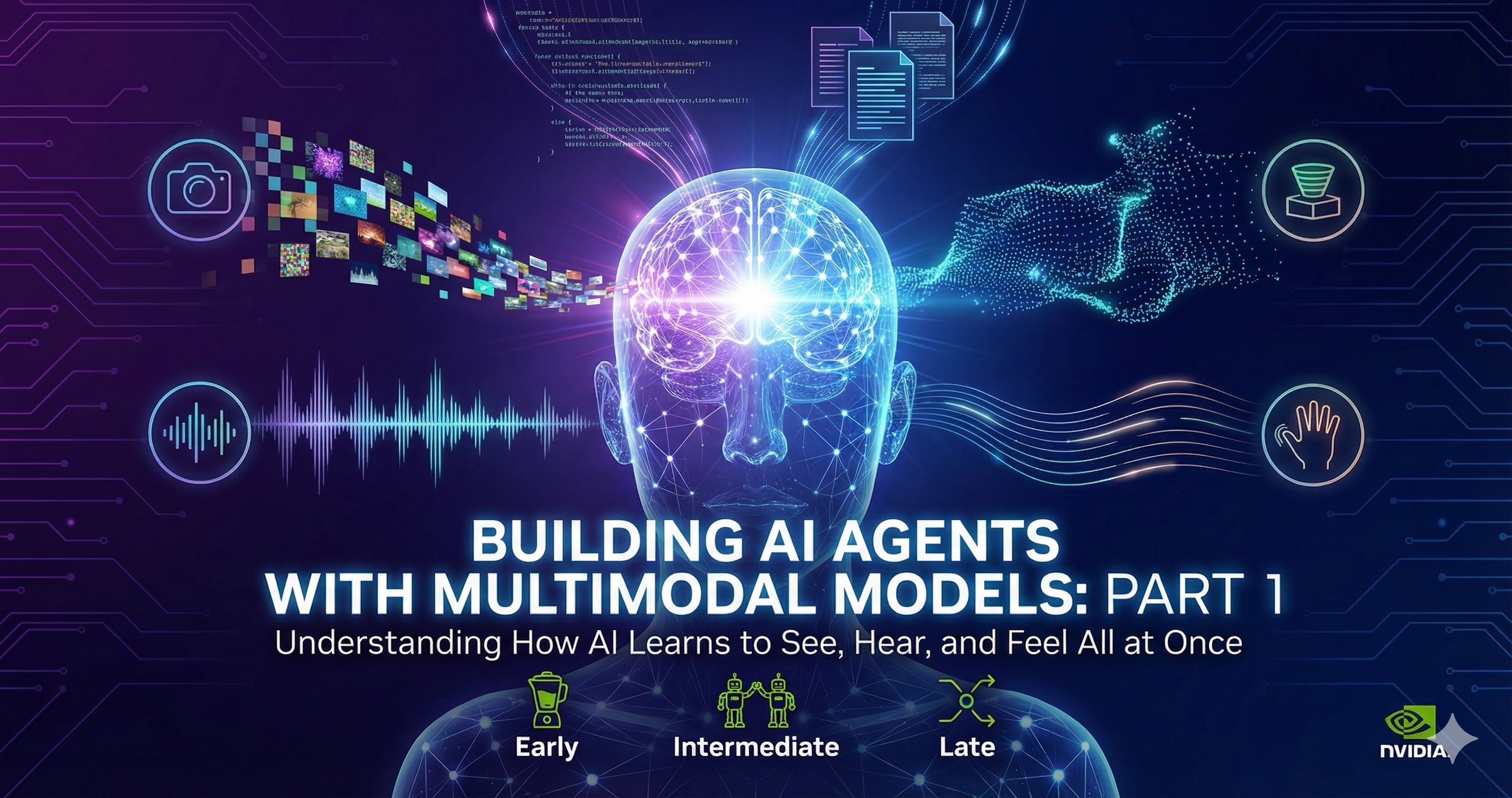
Understanding How AI Learns to See, Hear, and Feel All at Once
Why Do We Need Multimodal AI?
Imagine you're trying to identify a fruit in complete darkness. You can feel its round shape, its smooth skin, and smell its citrusy aroma. Now imagine you can only see a photo of it but can't touch or smell it. In either case alone, you might confuse an orange with a tangerine. But combine all your senses together, and suddenly the identification becomes much easier.
This is exactly the challenge AI faces. Traditional AI models are like humans with only one sense. A camera sees colors but doesn't understand depth. A LiDAR sensor measures precise distances but sees the world in points, not colors. Neither alone tells the complete story.
Multimodal AI is about teaching machines to combine multiple "senses" to understand the world more completely.
The Core Problem: Different Data Types Don't Speak the Same Language
Here's where it gets interesting. When you combine senses, your brain does it effortlessly. But for computers, mixing an image (a grid of pixels) with depth data (a cloud of 3D points) is like trying to add apples and equations together. They're fundamentally different.
Think of it like this:
- RGB Image Data: A painting on a flat canvas with colors
- LiDAR Point Cloud: A 3D sculpture made of tiny dots
- Text: A story written in words
- Audio: Vibrations over time
The magic of multimodal AI lies in finding smart ways to combine these completely different data formats.
The Three Fusion Strategies: When to Combine Your Ingredients
Just like cooking, the order in which you combine ingredients matters. NVIDIA's training introduces three fundamental approaches to fusion, each with its own strengths.
1. Early Fusion: Mix Everything at the Start
The Analogy: Making a smoothie. You throw all your fruits into the blender right at the beginning and blend them together.
How It Works: Concatenate (stack) all your input data together before feeding it into a single neural network. If your image has 3 color channels (RGB) and your depth map has 1 channel, you create a 4-channel input.
When to Use It:
- When your modalities capture complementary low-level features
- When the raw data naturally aligns (same resolution, same timestamps)
- When you want a simpler, more efficient architecture
The Trade-off: You're betting that the network can figure out how to use both data types from the very beginning. Sometimes this works beautifully. Other times, the model gets confused trying to learn two things at once.
Input A ─┐
         ├──> [Concatenate] ──> [Single Neural Network] ──> Output
Input B ─┘
2. Late Fusion: Let Experts Work Separately, Then Vote
The Analogy: A panel of specialist doctors. The eye doctor examines vision, the hearing specialist checks audio, and at the end they meet to discuss and reach a combined diagnosis.
How It Works: Train separate neural networks for each modality. Each network becomes an expert at its own data type. At the very end, combine their predictions (by averaging, voting, or concatenating).
When to Use It:
- When each modality has unique patterns that require specialized learning
- When you want modality-specific interpretability
- When you have pre-trained models for individual modalities
The Trade-off: You need more parameters (two full networks instead of one). But each network can fully focus on mastering its own domain without interference.
Input A ──> [Network A] ──> Prediction A ─┐
                                          ├──> [Combine] ──> Final Output
Input B ──> [Network B] ──> Prediction B ─┘
3. Intermediate Fusion: Meet in the Middle
The Analogy: Jazz musicians improvising together. Each plays their own instrument, but at key moments they sync up, listen to each other, and let one musician's riff influence another's response.
How It Works: Each modality has its own pathway that extracts features. At intermediate layers (not the beginning, not the end), these pathways exchange information. This exchange can happen through:
- Concatenation: Stacking feature maps together at a middle layer
- Matrix Multiplication: Having features from one modality modulate or gate the other
When to Use It:
- When you want the best of both worlds
- When modalities need some individual processing before they can meaningfully interact
- When you need rich cross-modal interactions
The Trade-off: More complex to design. You need to decide where and how fusion happens.
Input A ──> [Early Layers A] ──┐
                               ├──> [Fusion Layer] ──> [Later Layers] ──> Output
Input B ──> [Early Layers B] ──┘
A Practical Example: Colored Cubes with RGB and LiDAR
NVIDIA's training uses a brilliant example to demonstrate these concepts. Imagine a scene with three cubes: one red, one green, and one blue. Your task is to classify which cube is which.
Challenge 1: RGB Camera Only The camera sees colors perfectly. Red cube? Check. Green cube? Check. But wait, where exactly are they in 3D space? The camera flattens everything to 2D. If the cubes overlap visually, things get confusing.
Challenge 2: LiDAR Only The LiDAR sensor knows exact 3D positions. It can tell you precisely where each cube sits in space. But all cubes look the same because LiDAR doesn't see color.
The Solution: Combine Both With multimodal fusion, the model gets the best of both worlds. LiDAR provides spatial precision while RGB provides color identification. Together, they solve what neither could alone.
This is multimodal AI in action: combining complementary strengths to overcome individual weaknesses.
Key Takeaways
Multimodal AI combines different data types (images, text, audio, depth) to create more robust understanding
Fusion timing matters:
- Early fusion is simple but requires data compatibility
- Late fusion allows specialization but needs more resources
- Intermediate fusion offers flexibility but adds complexity
Choose your strategy based on your data: If modalities complement each other at a low level, go early. If they need expertise first, go late. If you need both, go intermediate.
The goal is complementary strengths: Each modality should bring something unique to the table
What's Next?
In Part 2, we'll explore how AI learns to connect completely different modalities through a technique called Contrastive Learning. Imagine teaching a computer that a photo of a dog and the word "dog" should live close together in the AI's understanding. This is the foundation of models like CLIP that power modern image search and generation.
This content is inspired by NVIDIA's Deep Learning Institute course: Building AI Agents with Multimodal Models. For hands-on experience, consider enrolling in their official courses.


